






Tome Of Madness Slot RTP In Italy 2026
Play Tome Of Madness in Italy with short sessions, clear limits and useful controls to manage budget and pace in 2026.
Understanding Tome Of Madness RTP Without Obsessing
When you read “return to player,” you are reading a concept, not a promise for your next session. It helps you understand how, in the long run, a slot tends to return part of the bets, but it says nothing about what happens in your next 10 or 100 spins. In 2026, many players in Italy seek quick certainties, and this is where the error arises: transforming a statistical indicator into an emotional expectation.
Imagine opening the slot after an intense day and thinking: “today I’ll make up for it.” If you start with that idea, every spin without a result seems unfair, and you feel like forcing it. Usually, those who manage the session better treat RTP as an informative note and focus control on what they can truly decide: duration, budget, and stop.
A practical way to use this concept without getting carried away is to ask yourself: am I trying to understand the game structure or am I looking for confirmations? If you want to understand, you observe the rhythm, try functions, and stop when you planned. If you are looking for confirmations, you extend the session and chase a “right” moment that does not depend on you.
All promotional incentive structure is clearly stated in writing and/or via electronic means in an easily understood manner. All codes are accompanied by an explanation of what the code is for, who is eligible to use the code, and how it should be used. As such, players are less likely to be confused about what is required of them in order to receive a reward and how the reward will be applied after receiving it. The promotional incentives provided to participants provide them with time to become familiar with the gaming system's mechanics, their interface, and progress, before deciding how deeply they wish to become involved with this platform. Therefore, players are encouraged to participate in an informed manner, rather than being pressured or tempted to act quickly.
Theme, Rhythm, and Gaming Sensations
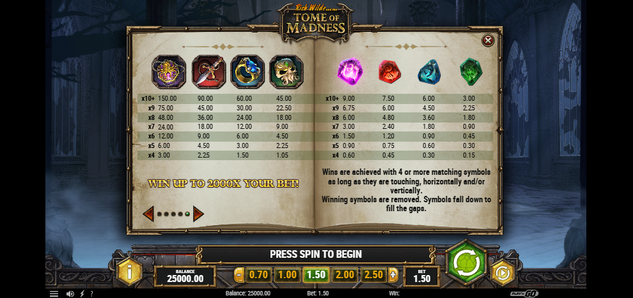
Tome Of Madness focuses on atmosphere: a dark imagery, books and symbols suggesting mystery, and a tension that grows when you feel something might activate. It's a slot that tends to reward those who stay clear-headed, because the real risk is not “losing a spin,” but losing control of the rhythm: accelerating, skipping breaks, changing bets without reason.
If you play on mobile, everything moves faster. Two taps and you're already in, and this makes it easier to slip into automatic mode. Imagine being on the couch, TV on, notifications coming in, and you spinning the reels almost without looking. Usually, in that context, worse decisions are made: not because the slot changes, but because you are less present.
To keep the experience enjoyable, it's best to choose a single goal per session: explore functions, relax with a light budget, or do a short test and then close. When the goal is unique, choices become simpler. And simple choices are those that hold up even when emotions run high.
How to Start in Italy with a Clear Routine
Starting well means creating a solid foundation even before thinking about bets. In Italy, access to gaming platforms is designed for adult users and requires a responsible approach: orderly registration, consistent data, active limit tools. It's not bureaucracy for its own sake, it's a way to avoid problems when you want to make an important transaction or simply close the session without friction.
Imagine registering in a hurry, choosing a weak password, and leaving everything “by default.” Then, at the first hitch, you lose time and patience, and that frustration ends up in the gaming session. Usually, those who start calmly (a real five minutes) save themselves hours of nerves later on.
Treat the start as a checklist: security, limits, payment method, and only then play. If it seems like too much, reduce it to three steps: protect the account, set a budget, define a duration.
Registration And Profile Security
Registration should be a clean gesture: enter data accurately, check for consistency, and protect access. If the platform offers additional verification tools, it's worth using them, as they reduce the risk of unwanted access and help you manage operations smoothly.
Imagine filling in the fields while distracted and misspelling a letter in your name. When you then need to confirm something, that letter becomes an obstacle. Usually, it's enough to reread everything twice: the first time for speed, the second for precision.
The environment also matters. Avoid shared devices, don't leave the session open “I'll be back,” and use a screen lock. These are trivial habits until they save you on a bad day.
Deposit And Budget Choice
Depositing is not “loading to play,” it's deciding how much you allow yourself today. A rule that works in 2026 is simple: only top up the amount for the session, not a supply for the week. This way, you don't have to negotiate with yourself while you're already in the rhythm of the slot.
If you tend to make repeated micro-deposits, put a structural brake on it: only one top-up per session, and then stop. Imagine losing a block and thinking: “I'll add a bit more and continue.” Usually, that “a bit more” repeats, and by the end of the evening, you no longer understand where you lost control.
Choose a budget that you can truly stick to. It doesn't have to be “perfect,” it has to be real. And above all, it must be independent of your mood: if you're nervous today, the budget doesn't change; instead, the decision not to play might change.
Micro-Checklist Before The Session
Check the time you actually have, set a duration limit, choose the session budget, and define an exit rule. Then do a verification round: useful notifications active, “recall” notifications reduced, and account protected. Imagine starting without these steps: you find yourself improvising when you're already involved. Usually, two minutes of preparation are worth more than any attempt to “recover” afterward.
Typical Mistakes To Avoid Immediately
First mistake: increasing the stake after a losing streak. Second: continuing after a winning streak “because today is my day.” Third: playing tired, with your head elsewhere. Imagine doing one of these and telling yourself that “you're in control anyway.” Usually, control collapses precisely when you feel confident and stop following the rules you had chosen.
Payments, Withdrawals And Account Support
Managing your account means eliminating chaos. A stable payment method, a history you check often, and clear communication with support when needed. In Italy, as everywhere, problems arise mainly when you change methods at the last minute or when you try to make important transactions in a hurry.
Imagine wanting to withdraw immediately after a good session, but you're tired and want to finish in two minutes. If something requires additional verification, you get nervous, and frustration makes you go back to playing “to let off steam.” Usually, the best way is the opposite: manage payments and verifications when you are clear-headed, not when you are emotional.
Simplicity wins here: few moves, always the same. Deposit with criteria, play in blocks, check history, close.
|
Area |
What You Need |
What To Check |
Helpful Habit |
|
Top-ups |
Convenient and clear method |
Personal limits and confirmations |
One top-up per session |
|
Withdrawals |
Consistent data and calm |
Header and required steps |
Prepare verifications in advance |
|
History |
Clear view of movements |
Dates, amounts, notes |
Control after each session |
|
Assistance |
Quick answers |
Precise question and useful details |
One topic per message |
Payment Methods: What to Check
When choosing a method, think about two things: how easy it is to use and how easy it is to control. If it leads to impulsive top-ups, it's not suitable for your style. If, on the other hand, it allows you to immediately see how much you've decided to use, it helps you stick to the plan.
Imagine topping up “just a little” multiple times because you don't want to stop. Usually, the method isn't the problem; it's the absence of a rule. That's why it's good to set a simple barrier: if you want to continue, you must first take a break away from the screen. If you still want to after the break, then decide. Not while you're in the middle of it.
Also pay attention to notifications: having an alert about transactions often reduces the illusion of "not having spent that much." It brings you back to reality without moralizing.
Withdrawals: How to Prepare Calmly
Withdrawal is a phase that requires patience and consistency. If your profile data is aligned and you maintain a stable path, the experience is usually smoother. Avoid sudden changes: changing methods or modifying data at the moment you want to withdraw creates confusion and lengthens perceived times.
Imagine requesting a withdrawal late at night, wanting to end the day "on a high note." If an extra step emerges, tiredness makes you misread and make mistakes. It's usually better to postpone it to a quiet moment and complete the steps with a clear head.
A good practice is to keep a simple note: date, amount, and duration of the session. It's not accounting, it's memory. It helps you understand if you're playing as you intended.
Support: Short Messages That Solve
Support works when you are clear. Write what you see, what you have already tried, and what you want to achieve. Avoid long stories, avoid assumptions, and ask one question at a time. This reduces unnecessary steps and leads to a more concrete answer.
Imagine being frustrated and sending a message full of emotions. Usually, they ask you to clarify, you waste time, and frustration grows. If, instead, you write concisely, with two useful details, support can work better, and you remain calmer.
And if you're nervous, do one simple thing: write the message, wait a minute, reread it, and cut half the words. It almost always becomes more effective.
Risk and Time Management During Sessions
Risk management is not an "expert strategy"; it's a daily choice: how much time you play, how much you allow yourself, and when you stop. In a dark and intense slot like this, the most common risk is emotional: you convince yourself that a moment is special and change your behavior.
Imagine being halfway through a session, feeling close to something, and starting to click faster. Usually, that's the point where the brain looks for a shortcut and loses clarity. The solution isn't "concentrating more"; it's stopping, taking a break, and resuming only if you still have a plan.
The golden rule in 2026: short, repeatable sessions, with real breaks. This way, you don't turn the game into a chase.
Game Blocks and Scheduled Breaks
Playing in blocks means defining a mini-unit: a limited number of spins, then a break, then a decision. This prevents you from slipping into the session without realizing it. The break must be away from the screen: get up, drink water, look away.
Imagine telling yourself "just five more minutes" and repeating it three times. It's the most common form of self-negotiation. Usually, a timer solves more than willpower: when it rings, close, take a break, and only then decide if you want to restart.
If you want an extra trick, change context. Don't play in bed, don't play while working, don't play when you're already irritated. Eliminating "bad" sessions is more useful than trying to make "good" sessions perfect.
Stop-Loss and Stop-Win Without Chasing
Two thresholds, one for loss and one for win. The second is fundamental: it protects you from the euphoria that makes you stay too long and give everything back. The thresholds must be simple and real, otherwise you ignore them.
Imagine getting a good result and thinking: "Today's my day, I'll push it." If you continue on adrenaline, you often return to square one. It usually works to close when you're ahead, take a break, and decide later. You're not giving up, you're protecting a choice.
When you reach a threshold, make a physical gesture: close the app and put your phone away for a few minutes. That gesture breaks the impulse.
When to Reduce Your Bet Instead of Increasing It
The classic temptation is to increase after a losing streak. In reality, when you feel that urge, you should usually do the opposite: reduce your bet or close the session. Increasing is an emotional response, not a decision.
Imagine losing two blocks and raising "just a little" to get back in. If you do that, you're turning the session into a recovery, and recovery is the slipperiest slope. It's usually better to slow down: lower bet, shorter block, break. And if the frustration remains, close for the day.
Reducing your bet can also be useful when you're too euphoric. It brings you back to a level where you make cleaner decisions.
Timeout and Self-Exclusion to Stay in Control
If the rules don't hold, use the pause tools. A timeout isn't a drama, it's maintenance. If you find yourself returning out of habit, or often breaking your thresholds, a longer break can give you back freedom of choice.
Imagine opening the game every evening without thinking, as if it were a reflex. Usually, it's no longer fun, it's routine. In that case, a planned break breaks the chain and allows you to choose again, with a little distance.
During the timeout, fill your time with something concrete: walking, sports, cooking, calling a friend. If you keep scrolling on your phone, you'll return too easily.
Tome Of Madness Review: Who Really Likes It
This slot appeals to those who love the atmosphere and can stick to an orderly session. If you're only looking for "quick hits" and get irritated when the pace slows down, you risk having a bad experience. But if you like short sessions, with a clear goal and a clean exit, the experience becomes much smoother.
Imagine two players: one enters to relax and closes after their block, the other enters to prove something and stays until they feel satisfied. Usually, the first one leaves lighter, even when the results aren't brilliant, because they stuck to the plan. The second one leaves tired, even when they had good moments, because they let the session guide them.
In 2026, the best criterion isn't "how much can it pay," but "how much does it keep me clear-headed." If a game pushes you to be impulsive, it's not the right game for that day.
Final Tips for 2026 and Beyond
Simplify everything. One payment method, one top-up rule per session, a clear duration, a real break. Then repeat. It's boring to read, but effective to live by.
Imagine a normal evening: you have little time, play two blocks, check your history, and close. You're left with the feeling of having chosen, not of having been dragged along. Usually, that feeling is worth more than any chase.
If you want to be even more practical, make a mini-note after each session: "I was calm" or "I was nervous." In a few weeks, you'll understand when it's best not to play. And that is, in reality, the strongest decision.
FAQ
How to interpret player return without expectations?
Player return is a statistical concept over the long term, not an indication for your next session. Imagine using it as a personal promise: every spin without a result seems "wrong" and pushes you to force it. It usually works to treat it as general information and focus control on budget, duration, and stops, which are the only levers that depend on you.
What is a simple routine for short mobile sessions?
Choose a budget for the single session, set a timer, and play in blocks: one block, off-screen break, then decision. Imagine saying "just five more minutes" multiple times: it's the most common way to overspend without realizing it. Usually, a timer and an immediate closing rule reduce the impulse and make the session lighter.
What to do if you feel the urge to chase a loss?
Stop immediately and change context for a few minutes, because chasing is an emotional reaction. Imagine raising your bet "to get back in" while you're irritated: you're choosing less and reacting more. It usually helps to close the block, take a real break away from the phone, and only resume if you can calmly redefine time and budget.
How to avoid giving back a win by continuing to play?
Decide on an exit threshold beforehand and stick to it when it arrives, without thinking that "now it continues." Imagine the euphoria phase: you feel in control, you accelerate, and in a short time, you're back to square one. It usually works to treat the win as a signal to close, take a break, and postpone the decision to re-enter until you're clearer-headed.
When is it advisable to use a longer timeout?
When you notice that you often break your rules, return out of habit, or play even without wanting to. Imagine opening the app every evening as an automatic gesture: it's no longer a choice, it's a routine. Usually, a timeout of a few days breaks the chain and gives you back mental space; during the break, fill your time with concrete activities so you don't return by reflex.
How to write to support to resolve issues faster?
Write in a few lines what you see, what you've already tried, and what you want to achieve, asking one question at a time. Imagine sending a long, confused message while you're frustrated: usually, they'll ask for clarification and you'll waste time. A concise text, with two useful details and a precise request, reduces steps and also helps you stay calm.
What signals indicate that it is better to close immediately?
Typical signs are irritation, increased speed, a desire to change the bet without reason, and thoughts of recovery. Imagine clicking faster because “it has to happen”: it’s a warning sign, not a positive one. Usually, closing, putting the phone away, and taking a real break breaks the impulse and brings you back to making clear choices.